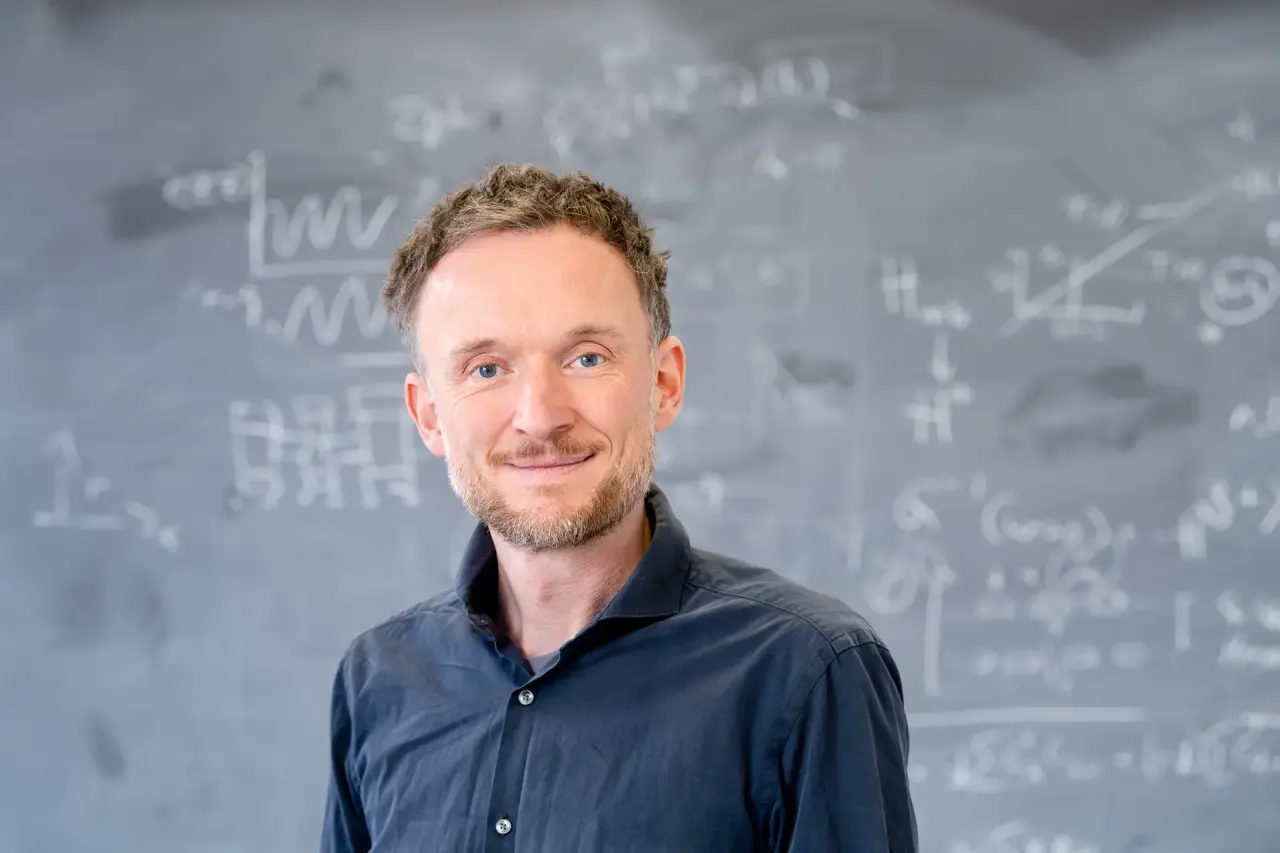
Frank Pollmann named 2026 Fellow of the APS
12 October 2026
Recognized for pioneering research on quantum entanglement and quantum matter.
Prof. Frank Pollmann of the Technical University of Munich (TUM) School of Natural Sciences and MCQST member has been named a 2026 Fellow of the American Physical Society (APS) in the Division of Condensed Matter Physics. He was recognized for his “pioneering research on quantum entanglement in quantum matter.”
Pollmann's research has helped shape the emerging field of quantum matter, bridging condensed matter physics, quantum many-body dynamics, and quantum information science. His work has advanced our understanding of quantum entanglement, the unique correlations between quantum particles that determine the behavior of many quantum materials.
To study these complex systems, Pollmann has developed widely used computational methods based on tensor networks. These algorithms place quantum entanglement at the center of simulations, enabling researchers to tackle problems that were previously beyond the reach of classical computing. He also co-initiated the open-source software package TeNPy, making these tools accessible to researchers worldwide.
More recently, Pollmann and his colleagues at TUM have expanded this work to quantum computing. They have pioneered approaches for creating and studying topological phases of matter on quantum processors, including the realization and investigation of topologically ordered quantum states.
Through advances in theory, computation, and quantum simulation, Pollmann's research has opened new pathways for exploring quantum matter and strengthened the connections between condensed matter physics and quantum information science.
Article adapted from the original on TUM NAT School.
About the APS Fellowship Program
The APS Fellowship Program recognizes Society members who have made exceptional contributions in physics research, important applications of physics, significant contributions to physics education, or leadership in or service to APS; and that each year, no more than one-half of 1% of the Society membership, excluding student members, is recognized.